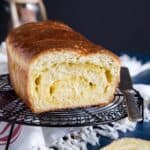
Coconut Bread Recipe with Brioche Dough
This Brioche Coconut Bread is made from an incredibly rich, buttery, soft, and slightly sweet brioche bread filled with swirls of sweetened coconut paste. It is the ultimate breakfast toast to give you a little sweet morning pick me up.
Servings: 10 slices
Equipment
Ingredients
Bread dough
- 3 large eggs room temperature
- 2 - 3 tablespoon of milk room temperature, 28 - 42 g
- 2 teaspoon of active dry yeast
- ¼ cup of granulated sugar 45 g, divided
- 2 cup all-purpose flour 265 g
- 1 teaspoon of kosher salt
- 4 ounce unsalted butter thin slices, room temperature, 113 g
- Extra flour for rolling as needed
Coconut Filling
- 1 ½ cup unsweetened shredded coconut 135 g
- 1 cup powdered sugar 100 g
- 1 large egg
- 1 tablespoon coconut oil 13 g, melted
Egg wash
- 1 whole egg
- 1 tablespoon milk or water
Instructions
- Make the brioche dough: mix 2 tablespoons of milk together with 1 teaspoon of sugar, and sprinkle the active dry yeast on top. Let it bloom for about 10 minutes. The mixture should puff up, if not, repeat this step to ensure yeast is working.
- In a small mixing bowl, add the remaining sugar, flour and salt and whisk to evenly distribute.
- In the bowl of your stand mixer, lightly beat the eggs with a hand whisk. Add the bloomed yeast mixture along with the flour mixture to the beaten eggs. Use the dough hook to knead on low speed (speed 2) for 15 minutes.
- Check occasionally to see how your dough is looking, if it is too dry, sprinkle in the remaining 1 tablespoon of milk. By the end of 15 minutes, it should pull away from the side of the bowl.
- Leave the mixer on speed 2 and add the softened butter, a few pieces at a time, allowing the butter to combine with the dough before adding more. This will take about 10 minutes. Then let the mixer knead for another 10-20 minutes or until the dough pulls away from the side of the bowl.
- Scrape the dough out on a lightly floured counter and shape into a ball. Place it into an oiled glass bowl and let rise at room temperature for 1 hour.
- At this point, you can let the dough ferment in the fridge overnight, or let it double in size (approximately 1-1.5 hours) and move on to the next step.
- Make the coconut filling: add unsweetened coconut and powdered sugar in the bowl of a food processor and pulse to mix. Add the egg and 1 tablespoon of coconut oil and pulse until a paste forms. Set aside.
- Assemble the coconut bread: let the dough come to room temperature if you just remove it from the fridge and make sure it has doubled in size before working with it.
- Brush a loaf pan with melted butter or coat with nonstick spray. Line the pan with a piece of parchment paper leaving some excess hanging out on both sides. Then coat the parchment paper with melted butter or nonstick spray as well.
- Scrape the dough out onto a lightly floured countertop. Deflate the dough and roll it out into a rectangle about 8”x13”.
- Spread the coconut paste on top of the dough as evenly as possible and roll it up starting from the shorter side.
- Place the dough into the prepared loaf pan, cover with a tea towel or plastic wrap, and let rise in a warm spot for 1.5 - 2 hours until at least double in size.
- Preheat the oven to 350°F.
- Beat an egg with a tablespoon or water or milk to make egg wash. Brush the top of the risen dough with egg wash and bake for 40 minutes until golden brown, and an inserted wooden skewer comes out clean. During the last 10 - 15 minutes, if the bread is getting too brown, drape a piece of foil over it to prevent it from burning.
- Remove from the oven and let cool to the touch on a wire rack before attempting to remove it from the pan. Allow the bread to cool completely before slicing into it. Use a serrated bread knife to slice.
Notes
- Always check that your yeast is working properly before continuing with the recipe to ensure success. If the yeast doesn’t puff up when bloomed in liquid, it is best to start over. Otherwise, your dough will not rise.
- Rising time can vary, depending on the environment: temperature, humidity, barometric pressure. The dough will rise faster in warmer weather compared to colder weather, in higher altitude compared to lower altitude, etc.
- Cutting the butter into thin slices will help it incorporate into the dough easier than cubes.
- Make sure the butter is at room temperature or it will not incorporate easily.
- This dough is very buttery so it shouldn’t need a lot of extra flour for rolling and shaping.
- At any point during baking, if the top of the bread is getting too brown, you can cover it with a piece of foil to avoid over-browning or burning.
- If you had lined the pan with parchment paper, simply lift the bread out of the pan. Otherwise use a butter knife to loosen the sides and flip it out onto a tea towel or wire rack.
- If you don’t have a food processor to make the coconut filling, simply mix by hand but make sure to choose a more finely shredded coconut.
Nutrition
Serving: 97g | Calories: 352kcal
