


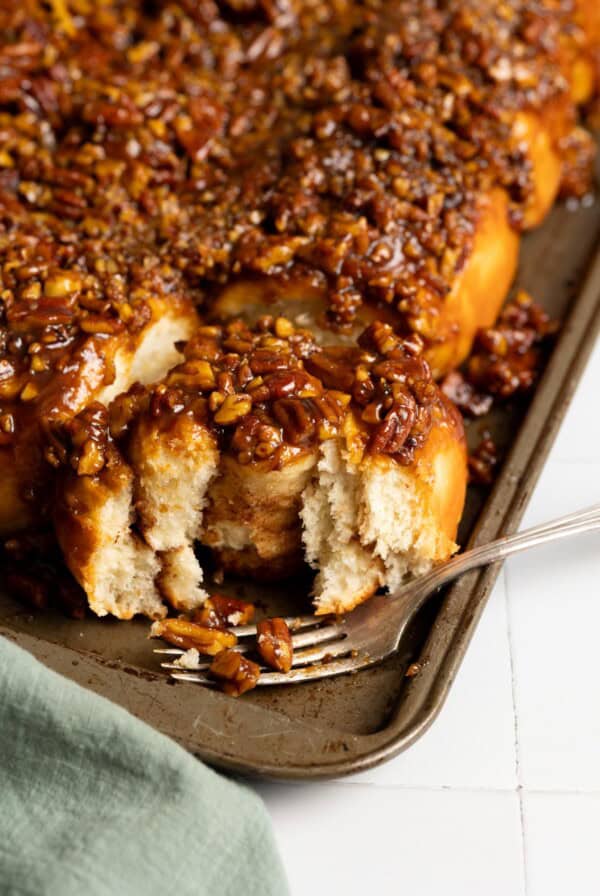
Pani Popo are soft and delicious Samoan coconut buns baked in a luxurious coconut sauce. Meet your dinner-rolls-on-steroid with golden brown top, fluffy cloud-like interior, swimming in a pool of creamy coconut sauce.

My first time trying Pani Popo was at a Hawaiian festival called Heritage of Aloha in Southern California. We go every year mostly for the amazing food, but of course there are lots of fun activities, performances, and awesome vendors you can check out if you ever have a chance to attend. During the few years that the festival took a hiatus, I had no choice but to come up with my own Pani Popo recipe to get me through the days.
I used my easy milk bread dough but increased the quantity of the recipe for that super soft and fluffy texture. And then the dough is baked in a pool of the same coconut sauce that I also used in this macadamia coconut rolls recipe.
Table of Contents
Helpful tools
You can use a stand mixer with the dough hook to make your bread dough. It is possible to make the dough by hand but it does make it a lot easier with a mixer.
A thermometer is useful to check the liquid temperature before activating the yeast in the warm liquid. But you can get by without one.
Ingredients and substitutions
As always, you’ll find the complete list of ingredients and quantities in the recipe card at the end of this post. Below are some notes and substitution tips:
- Heavy cream – because the bread dough is made with just milk and heavy cream, no eggs, no butter, the heavy cream provides all the fat and richness, so I don’t recommend substituting with all milk. You can use half and half to replace both the cream and milk together.
- Milk – whole milk or 2% milk will work, or half and half to replace both the milk and cream.
- Sugar – I used granulated sugar in this recipe but brown sugar will work too.
- Yeast – you can use active dry yeast or instant yeast. Both will work just fine in the bread. Even with instant yeast, I usually activate it the same way I do active dry yeast to make sure it is working properly before preparing the bread dough.
- Salt – I use kosher salt. You can use table salt but use half as much.
- Flour – AP flour is just fine for this recipe.
- Coconut milk or coconut cream – make sure it is canned coconut milk and not coconut milk from the carton. The higher fat content of canned coconut milk or cream makes a richer and more delicious sauce.
- Cornstarch – a small amount is used to thicken the coconut sauce.
How to make Pani Popo from scratch
The following instructions, step-by-step photos, and tips are here to help you visualize how to make the recipe. You can always skip straight to the printable recipe card at the end of this post.
Make the bread dough
First, heat your cream, milk and sugar in a saucepan until the sugar dissolves and the mixture is simmering but not boiling. Let it cool down to about 110°F — if you don’t have a thermometer, check with your finger, the liquid should feel warm to the touch but not hot. Sprinkle in the the yeast, and let it sit for 5-10 minutes until puffy, that’s the sign the yeast is working!

Tip: It’s okay with the liquid is cooler than 110°F, you just don’t want it to be too hot since that can kill the yeast. Use this method for both active and instant yeast.
Mix together your flour and salt in a separate bowl. Add your yeast mixture and your dry ingredients to your stand mixer bowl. Knead with the dough hook until the dough comes together, about 10 minutes and up to 20 minutes.
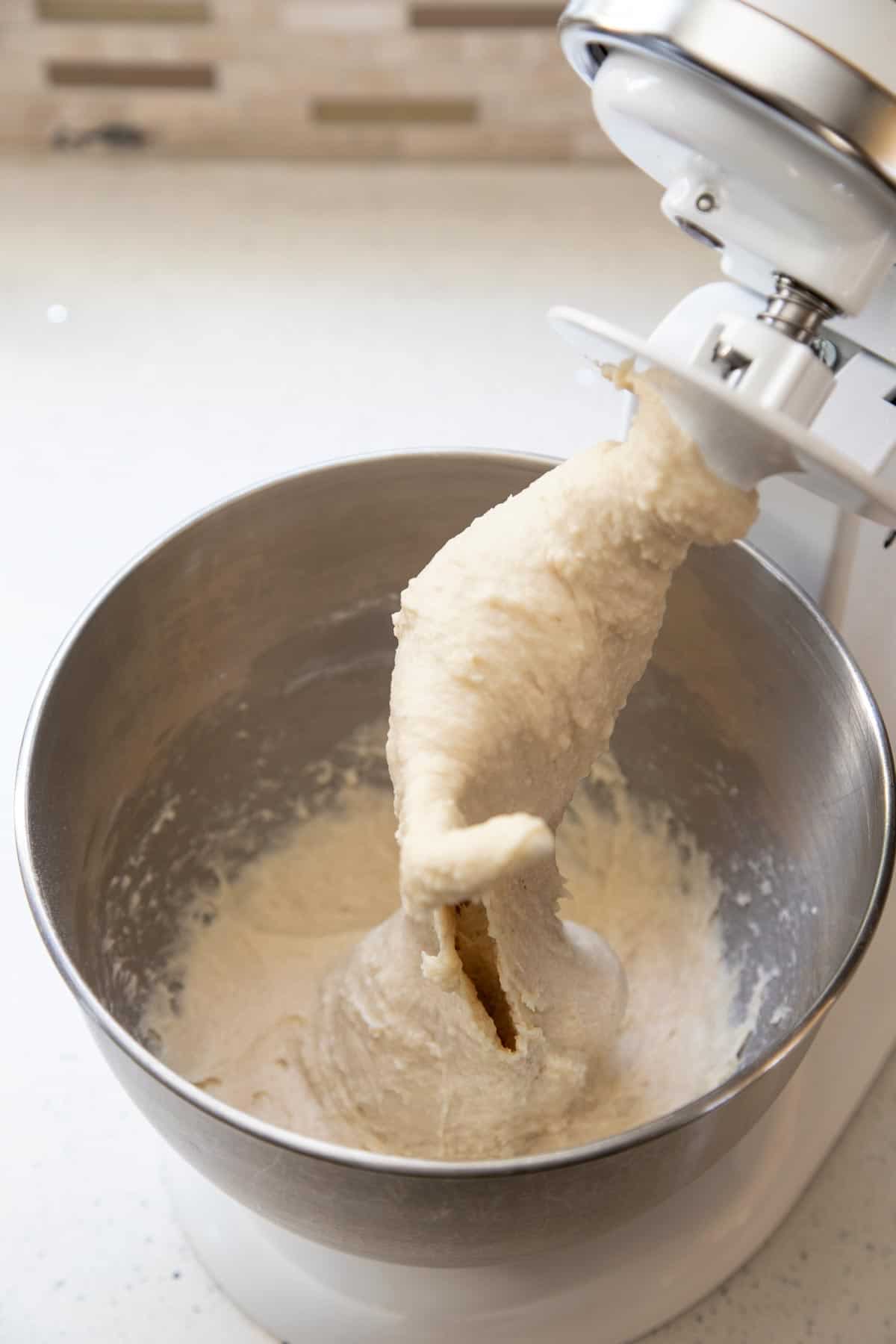
Tip: It is helpful if you have a stand mixer to make this dough. However, you can certainly make it by hand, mix the dough with a spatula or wooden spoon.
Form a ball and place the dough into an oiled bowl. Let the dough rise until at least double in size, 1 to 2 hours.

Tip: The dough may be a little bit sticky at this stage. Try not to add too much flour while shaping it. After the first rise, it will be less sticky.
Form the buns
Once the dough doubled in size, turn it out on a lightly floured surface and divide into 12 equal portions. Roll them into balls and place into a buttered 9”x13” baking dish. Let them rise for the second time until doubled in size.

Make the coconut sauce
You should prepare the sauce while waiting for the buns to rise the second time in the baking dish. First, make the cornstarch slurry by dissolving the cornstarch with a bit of coconut milk.

Then, cook the remaining coconut milk with sugar and a pinch of salt until simmering, drizzle in the cornstarch slurry and continue cooking until thickened, like this Haupia coconut pudding but not as thick!

Bake your pani popo
When the buns have doubled in size and puffy, they are ready to go into the oven, pour the coconut sauce all over the buns. Bake until golden brown.

Make ahead tips
Option 1: This bread dough can be made 2 – 3 days ahead and allow to rise slowly under refrigeration for its first rise. So after you take the dough out of the stand mixer and form the dough ball, instead of letting the dough rise in a warm spot, cover and refrigerate it. When you are ready to bake, let the dough come to room temperature and continue with the rest of the instructions.
Option 2: If you want fresh pani popo for Sunday brunch instead of dinner, you can prepare the dough the night before, form the buns in the baking pan and let them rise overnight in the refrigerator. Take the buns out in the morning and let them come to room temperature and finish rising. Make the coconut sauce while you wait and then bake.
If you love these buns for brunch, I think you’ll also enjoy this coconut swirl brioche and these Chinese-bakery-inspired coconut buns.
Storage
These coconut buns can be kept at room temperature for 2 – 3 days, wrap tightly. They can also be refrigerated for up to a week. Warm them up in the microwave for about 20 – 30 seconds before serving.

Hungry for more?
The Softest and Fluffiest Pani Popo

Equipment
- 9"x13" Baking Pan
- Thermometer
Ingredients
Dough
- ¾ cup heavy whipping cream, 180 g
- ¾ cup milk, whole or 2%, 180 g
- 6 tablespoon granulated sugar
- 1 ½ teaspoon active dry yeast
- 1 teaspoon kosher salt
- 3 cup all-purpose flour, 390 g
- Additional flour for rolling
- Melted butter for baking dish
Coconut Sauce
- 1 can coconut milk, or coconut cream, 13.5 oz
- ⅓ cup granulated sugar, or brown sugar, 65 g
- A pinch of kosher salt
- 1 tablespoon cornstarch
Instructions
Prepare the buns
- Add cream, milk and granulated sugar to a small saucepan and bring to a simmer over medium heat, stirring constantly, about 5 minutes. Transfer to the stand mixer bowl and allow the mixture to cool down to below 110°F, check with a thermometer.
- Sprinkle active dry yeast over the top of the milk mixture, stir and let it bloom for about 10 – 20 minutes. The mixture should visibly puff up.
- In another mixing bowl, sift the flour and stir in the salt. Add the flour mixture to the liquid mixture and knead with the dough hook on low speed until everything is incorporated and a wet dough forms.
- Scrape the dough out onto a floured countertop and knead a few times to form a ball. Place the dough ball into an oiled large bowl, cover with plastic, and allow it to rise in a warm spot until doubled in size, about 2 hours.
- Melt a tablespoon of butter and brush it all over your baking dish and set aside.
- When the dough is ready, dump it out onto a floured countertop and divide it into 12 equal portions. You can eyeball this step or use a scale to be exact, each buns is about 67 grams or about 2 ⅓ oz.
- Shape each portion into a round bun and place them into the buttered 9”x13” baking dish and allow them to rise for another hour until double in size.
Make the coconut sauce while the buns are rising
- Whisk the cornstarch with about ¼ cup of room temperature coconut milk until completely dissolved. Set aside.
- Add the remaining coconut milk to a small saucepan along with sugar and salt. Cook over medium heat, stirring frequently until the sugar dissolves completely and the mixture starts to simmer.
- Drizzle the cornstarch mixture into the simmering coconut milk, stirring constantly. Continue to cook for another 2 – 3 minutes until the sauce starts to thicken. Take it off the heat and set it aside to cool a bit.
Bake the buns
- When the buns have doubled in size, preheat the oven to 400°F.
- Drizzle at least 1 cup of coconut sauce over all of the buns and bake for 20 – 25 minutes until the top is golden brown.
- Take the buns out of the oven, allow to cool slightly before serving. Serve with the remaining coconut sauce.
Notes
- The dough can be made without a stand mixer, just mix the flour into the liquid with a spatula or wooden spoon and knead by hand.
- This dough is very soft and sticky when it first comes out from the mixing bowl. Try not to add too much flour when handling it. After the first rise, it will be much less sticky and easier to handle.
- Be sure to use canned coconut milk for the sauce and not coconut milk in the carton.
Nutrition
Nutrition information is automatically calculated, so should only be used as an approximation.
 Like this recipe? Rate & comment below!
This post may contain affiliate links. For more details on how we utilize affiliates, ads, and sponsored content, see our full disclosure policy. Thank you for your continued support, which enables us to keep bringing you delicious recipes, at no extra cost to you.




Can I substitute the whipping cream with thickened cream?
Hi Miri, I have never used thickened cream before and just reading about it, it sounds like it has thickening agent? Is there something you can get that does not have thickening agent that has about 30-35% fat? I’m not really sure how thickening agents affect bread dough. If not you can sub the heavy cream with half milk and half butter, which should give you plenty of fat in the bread dough.
I’m not a new comer a too this awesome dessert I call it. Wanted to make it so got be on line. I’ve worked in a medium class restaurant 5 year and watched and learned Hawaiian food cooking growing up and in our hous e because we’re Hawaiian. Having a bunch of Samoan friends and classmates I never was told of Pani Popo? Now I know why,and too bad I found out after all these years. Thanks for the recipe and I had a feeling of making the sauce like Haupia but wanted to make sure I don’t over think it! Hope they have the Heritage of Aloha festival again so I can go eat wat get. In the restaurant job I was fortunate to have cooked with a top line chef who was local Japanese and top3 state wide and a classmats dad who knew 5 different culture cooking so we’ve done big and small any way be u want it! So mahalo and I’ll let u know how came out and fast it was gone!? Just me,..
Aloha ,
“Kona”
Aloha, mahalo nui! I hope you enjoy these. And hope the end to this pandemic is coming soon so we can go out there to support all the amazing local chefs and restaurants, and the come back of Heritage to Aloha.
Can I please have your recipe I really want to tasted,I love your pani popo
Hi Wilma, the recipe is at the end of the blog post, you should be able to see it on page.
These are soo good and soft! I replaced one cup AP flour with bread flour. I also might have thickened the coconut sauce too much because they didn’t brown as evenly as yours, but still delicious . Thank you!
I love these rolls! I’ve made them 3 times since you posted them in IG and just about to make them now! I follow your recipe as written and prefer to pour all of the coconut sauce on the rolls. I did the 1 cup the first time I made them and found that I didn’t even use the reserved sauce, so better for me to use it all! Thanks for a delicious recipe!!
Hi McKenna! I’m so happy to hear you like these rolls, yay! 🙂
hello! can i use bread flour instead of all purpose flour? i’m so excited to make these!
Yes certainly.
I love all your bread recipes and this is yet another winner. The texture is perfection.
Wow!! Wish I could post a picture! These turned out amazing! Love the fact that your milk bread doesn’t require powdered milk. I added 2TBS of ube powder and a tsp of ube extract to me dough and it was perfect!! The coconut sauce is perfect as well. Thanks for posting. I will be sure to try out more of your recipes! Thanks again for sharing 😋.
Awesome! Thanks Melissa! The addition of ube sounds fantastic 🙂
Have you tried any of these recipes with natural yeast / wild yeast?
I have not and can’t really give you the exact substitution but technically they should work if you use a sourdough starter instead of dry yeast.
These look amazing! I’m definitely going to try them. I’ll leave a rating when I do. Is the dough sweet?
Very slightly, there is sugar in the dough but it is not super sweet. Do come back and let me know how it turns out after you make it, thanks!
I’m so excited to make these! Ilove coconut everything.
Am I able to let my dough rise overnight in the fridge?
Yes, you can. But I notice since it’s been so cold lately, the dough actually doesn’t rise much once you put them in the fridge so I would allow it to rise for 1-2 hours at room temperature first, then refrigerate overnight, let come to room temperature again in the morning to finish rising and then bake. What I’ve been doing is making a makeshift proofer using hot water and the oven in the morning to get the dough up to room temperature quicker. Just pop the tray of already shaped buns in the oven on the top rack, put another glass baking tray in the bottom rack and fill with boiling water, close the oven and let it sit there for a while.
Hello! I am making this recipe now and I allowed my dough to sit overnight. Just made my buns and am letting those rise for an hour like recipe stated. Just in case if they won’t rise to double in size, what should I do?
Hi Dash, did you make sure the yeast bloom and is working properly? If it is, your dough should not have any problem rising. Did you let the dough rise overnight at room temp or in the fridge? Was it puffy this morning or was it deflated? If the buns don’t rise, you may have to throw the dough away because that means the yeast is dead. If it does rise but doesn’t double it size then it just means it needs more time. How are they looking right now?