


This is hands-down the easiest, silkiest Swiss Meringue Buttercream you’ll ever make—and yes, it works every single time! This recipe is tried, true, and well-tested. Thanks to a stable meringue base, it’s a dream to pipe or spread, with a smooth texture that holds up beautifully. Best of all, it’s endlessly versatile—perfect as-is or ready to be infused with your favorite flavors, like rich chocolate, zesty citrus, freeze-dried berries, espresso, or warm spices.

✨ Trang’s Recipe Highlights
- FLAVOR: not too sweet, rich, buttery with a hint of vanilla.
- TEXTURE: light and airy, smooth and luxurious, extremely silky.
- EASE: it does take more effort than just creaming together butter and sugar like a classic vanilla buttercream frosting, but this Swiss buttercream recipe is truly failproof! All my tips and step-by-step instructions with photos will ensure your success.
This recipe was originally adapted from Chef Duff’s Swiss Meringue Buttercream in Duff Bakes. It turned out that his recipe actually utilizes the French meringue method, which I will explain in the FAQs. I’ve since made it many many times using the Swiss meringue method instead – I found it to be more stable – and experimented with different flavors such as:
- Blueberry Swiss Meringue Buttercream for this Lemon Blueberry Cake
- Oreo Swiss Meringue Buttercream in these Cookies and Cream Cupcakes
- Mint Swiss Meringue Buttercream in these Christmas Pinata Cupcakes
- Espresso Swiss Meringue Buttercream for Mocha Cake and Mocha Cupcakes
Ingredients you’ll need
The 4 basic ingredients you’ll need to make a this Swiss buttercream are pictured below. Jump to the recipe card for the full list of ingredients with quantities and step-by-step instructions.

- Egg whites – you can use fresh egg whites, day-old-pre-separated egg whites, cold egg whites, room temperature egg whites or carton egg whites. I’ve tested this recipe with all of these successfully. While most blogger will advise against carton egg whites, I’ve tested this recipe with Target brand carton egg whites and it worked just fine.
- Unsalted butter – don’t substitute salted butter or you’ll end up with salty buttercream.
- Vinegar or Lemon Juice is an acid to stabilize the meringue. You can also use cream of tartar. This is a very important ingredient, without it the meringue can collapse.
- Sugar – I used vanilla sugar here but you can substitute granulated sugar and a teaspoon of vanilla extract.
- A pinch of salt is optional but I’ve been adding it to all my frosting recipes to enhance the flavor, mellow out the sweetness and add complexity.
Tips for making Swiss meringue buttercream
Make sure your equipment is clean
Meringue can be a challenge to make since just a spec of oil, butter or egg yolk can ruin it. So, to ensure you have the best outcomes, make sure all of your equipment, tools, utensils are clean, dry and grease-free.
Fully dissolve the sugar
You may end up with gritty buttercream if the sugar is not fully dissolved early on during the process. I’ve never experienced this first hand but I’ve always made sure to check the egg white mixture to make sure I can’t feel any sugar granules after it’s been heated up to 160°F.

Be gentle with the meringue
Once you’ve transferred the egg white mixture to a stand mixer, start on low speed and gradually increase to medium speed as the meringue starts to shape up and finish on medium high at the end when you get to stiff peak. Check the meringue along the way and stop as soon as you gets to stiff peak so you don’t over-whip it.

Don’t rush adding butter
Add just one cube of room temperature butter at a time and allow it to incorporate fully. Adding too much butter at once will increase the chance of the mixture splitting or curdling.

Splitting or curdling
Once you’ve added all of the butter to the meringue, the mixture may look broken like cottage cheese, this is normal. Keep beating it and the buttercream will come together.
I find that this “cottage cheese” stage is barely noticeable when using the Swiss Meringue method. It takes only a few minutes for the mixture to come together. But when using the French Meringue method, which I don’t recommend any longer, it can take a bit longer.
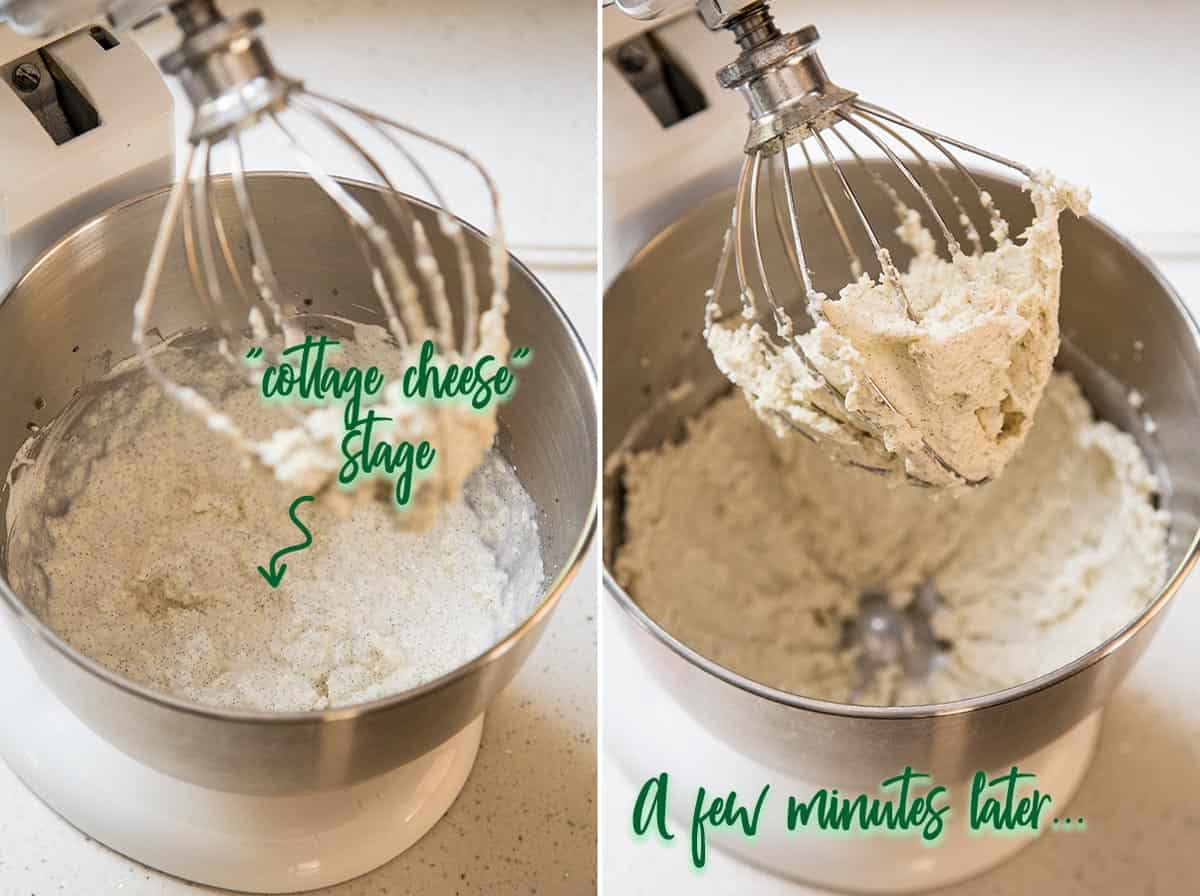
Too soft or runny
Make sure the meringue is not too warm when you start adding butter and make sure your butter is room temperature but not about to melt. You should be able to make an indentation on the stick of butter when pressed with your finger but it should not fall apart. Butter can become too soft during hot summer days.
Tastes just like a stick of butter
If your buttercream taste just like butter smeared on toast, that’s not very yummy on cakes. This does happens if you don’t incorporate enough air into the final frosting. The air whipped into the buttercream is what makes it light and fluffy, so be sure to beat it long enough to achieve that texture.

Other problems?
Check out this guide for rescuing your Swiss meringue buttercream.
Hungry for more?
Swiss Meringue Buttercream Recipe

Equipment
- Thermometer
Ingredients
- 4 oz egg white, 115 g, a smidge less than 4 large egg whites
- ¾ cup granulated sugar, or vanilla sugar, 135 g
- ¾ teaspoon distilled vinegar or lemon juice, 4 g
- 10 oz unsalted butter, room temperature, cubed, 283 g
- 1 teaspoon pure vanilla extract, omit if using vanilla sugar
- A pinch of kosher salt, optional, but recommended
Instructions
- Heat egg whites and sugar – Add egg white and sugar to a heatproof glass bowl and place it over a pot of boiling water without allowing the bottom of the bowl to touch the water, reduce heat to keep the water simmering and not boiling over. Whisk the mixture constantly until all the sugar dissolves and the mixture reaches 160°F.4 oz egg white, ¾ cup granulated sugar

- Make the meringue – Carefully remove the bowl from the pot and wipe the bottom and side dry. Transfer the egg white mixture into your stand mixer bowl and beat with the balloon attachment on low speed. Stream in the vinegar or lemon juice, and gradually increase the mixer speed to medium. Continue beating until stiff peak forms and the meringue is shiny and smooth. NOTE: Stop the mixer to check on the meringue throughout the process to ensure you don't overbeat it. Once it gets to medium peak, you can increase mixer speed to medium high to quickly beat it to stiff peak.¾ teaspoon distilled vinegar or lemon juice
- Add butter – Reduce the mixer to low speed and slowly add the room temperature cubed butter, one cube at a time, allowing it to incorporate into the meringue before adding another.10 oz unsalted butter
- Beat until fluffy – Once all the butter has been incorporated, add vanilla extract and a pinch of salt, increase the mixer speed to medium high and keep beating until the buttercream is light and fluffy.1 teaspoon pure vanilla extract, A pinch of kosher salt


Video
Notes
- This recipe yields 3 cups of vanilla Swiss meringue buttercream, enough for 15-18 cupcakes.
- Use clean, dry and grease-free equipment, tools and utensils to ensure your meringue will be successful.
- Dissolve the sugar is completely in the egg whites while heating so you don’t end up with gritty buttercream.
- If your buttercream looks separated or curdled at any point, just keep beating, it will come together eventually.
- Make sure your butter is soft but not melted, and the meringue is cool and not too warm before adding the butter so you don’t end up with runny frosting.
- Enough air needs to be incorporated to get that light fluffy buttercream texture. If you underbeat your buttercream, it will taste just like butter.
- This Swiss meringue buttercream can be kept at room temperature for up to 24 hours. Store it in an airtight container in the fridge for up to a week, or in the freezer for up to 2 months. If frozen, let the buttercream thaw at room temperature and re-whip until fluffy before using.
Nutrition
Nutrition information is automatically calculated, so should only be used as an approximation.
 Like this recipe? Rate & comment below!
Flavor variations
Like I mentioned above, I’ve used this base Swiss buttercream frosting to create many different delicious flavor. It’s very easy and I’ll give you some suggestions below:

- Similar to Chocolate Swiss Meringue Buttercream, you can add melted and cooled white chocolate, along with a splash of vanilla extract for a white chocolate version.
- For flavors you can only achieve using extracts like peppermint, almond, rose, start by adding a small amount and increase to your taste to make sure it doesn’t become too overpowering.
- You could also use lemon and orange extracts but I do like to add real citrus zest when I can get my hands on fresh oranges, lemons, limes, even grapefruits.
- I love using ground freeze-dried fruit to make a fruity flavor buttercream similar to this strawberry cream cheese frosting, this blueberry frosting and this pineapple frosting.
FAQs
Swiss Meringue Buttercream is a buttercream frosting that starts with a meringue base, which is made out of egg whites and sugar. The meringue is beaten to stiff peaks and stabilized with an acid such as vinegar or lemon juice. Then butter is added and beaten until a fluffy frosting is achieved.
Due to the stable meringue base, you can use a lot less sugar and still get a stable buttercream that won’t melt right away in slightly warmer weather.
The original recipe calls for beating egg whites and sugar without heating up the mixture. This was called to my attention by a reader that this is a French Meringue and not a Swiss Meringue because the meringue is “uncooked”. For a Swiss meringue, the egg whites and sugar mixture is heated up to 160°F.
I’ve since switched to using the Swiss Meringue method exclusively for a couple of reasons. One is food safety, and two is that the Swiss method in my experience creates a much more stable meringue that gets to stiff peaks a lot faster.
This post may contain affiliate links. For more details on how we utilize affiliates, ads, and sponsored content, see our full disclosure policy. Thank you for your continued support, which enables us to keep bringing you delicious recipes, at no extra cost to you.


Hi there,
When I poured the melted cooled chocolate into the SMBC, they hardened into chocolate pieces, would you happen to know why? THanks
Hmm… was the temperature of your chocolate and meringue too cool? what kind of chocolate did you use? Melting wafers, chocolate chips, bars? I’m not sure if I can give you an exact answer to this since I have never encountered it before and I make this buttercream a lot.
How many days can this be stored in the fridge if I cannot finish using it on one cake? Can I still use it for piping after it had been in the fridge? Will it change in texture?
You can see storage instruction under “Storage” within the post, also pasted here for you convenience: This buttercream can be kept at room temperature for up to 24 hours. Store it in an airtight container in the fridge for up to a week, or in the freezer for up to 2 months. If frozen, let the buttercream thaw at room temperature and re-whip until fluffy before using.
The texture will harden when it is cold, it’s best if you let it thaw a bit and rewhip until fluffy.
Hi.
Does this buttercream go firm enough to put under fondant?
Thanks,
Hi Antonietta, you could allow it to firm up in the refrigerator for about half hour after frosting and before adding the fondant.
I tried this recipe and loved it! I did the egg whites and sugar over a double boiler until they reached 160 degrees, then whipped them together for 10 minutes, then gradually added the butter. I added a little powdered sugar at the end just because I prefer that sweetness, but the ratio was awesome! For me it was just enough to crumb coat and frost a three layer four inch cake generously. Thank you!
Thank you Sarah! Glad to hear you loved it 🙂
Can I replace butter with margarine?
Hi Wande, I haven’t tried this myself so I do not know for sure. But if you use a margarine with the same fat content as butter (about 80%) I don’t see why it won’t work. However, it won’t have the same buttery flavor. Let me know if you try it and how it turns out!
Can i less the butter? Coz after taste of buttery
I haven’t tried with less butter so I’m not sure if it will come out as stable but if you try it, do come back and less us know!
I have to agree with the other comments about the misleading title. Without heating the meringue you cannot call it a “Swiss meringue” buttercream. It’s also not just a naming distinction though, because the process of heating the whites alters the nature of the proteins and this helps to stabilize the meringue and dissolve the sugar more than you could with the French style of making meringue which is unstable and unsuited to a butter frosting meant to hold up. You may have observed no significant difference between heating or not(possibly because you used egg whites which were further pasteurized), but your viewers looking may not experience the same results and be disappointed after following instructions not to heat a “Swiss meringue”.
I appreciate your input and will add my experience with heated Swiss meringue to the post as I have responded to the other comment.
this recipe doesn’t taste good the butter cream isn’t cream it’s just butter this recipe doesn’t work
I’m sorry you didn’t like it. The only thing I can suggest is to keep beating to aerate the cream until it is fluffy and creamy.
This isn’t even Swiss Meringue Buttercream. You have to heat the egg whites and sugar first before you whip them. This is just….not right.
You can certainly heat the egg whites and sugar over a pot of simmering water if you prefer. I’ve done it both ways, with heat and without, they both work.
This is a French meringue base, not Swiss. The element that makes a meringue Swiss is the technique used, ie. the process of heating the egg whites and sugar together using a double boiler. A French meringue is when the egg whites are whisked and sugar then added gradually, and then there’s Italian meringue where the sugar is heated to a sugar syrup and then slowly poured into the egg whites whilst whisking.
The reason the Swiss and Italian methods are used specifically for buttercreams is because the egg whites will have been subject to a specific amount of heat to make them safe for consumption, this is not the case with French.
Your recipe may well work in the sense that it produces a nice tasting buttercream but the name is misleading as it suggests one method but your post showcases a different one.
Hi Ellie, I appreciate the explanation on the difference between French and Swiss meringue. I have since made this recipe both ways and plan to add both methods to the post in the future for better clarity. However, I would note that the resulting buttercream is exactly the same and I don’t have such a strong opinion as you about what to call it. Again, I appreciate you taking the time to read through the post and add your knowledge to the discussion to help others learn. Have a wonderful day!